by James Gilmore
M. Night Shyamalan’s The Last Airbender is nothing short of a fiasco. Watching Airbender is like watching a group of kids play make believe on a $150m budget. Of its scant virtues are a solid midpoint with an interesting twist and beautiful cinematic scenery, neither of which are enough to save this film from ridicule and oblivion.
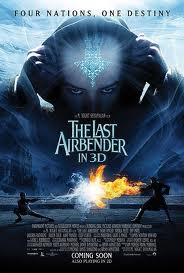
The plot is a series of anticlimactic events wherein few sources of conflict come to a head in a do-or-die confrontation. The acting lacks any sense of urgency, even at the most critical of moments, and most of the characters appear to have only a narrow range of emotions, most of which consist of being at the brink of bursting into tears at any given moment. Further exacerbating the problem, awkward, immature dialogue is almost exclusively expository and devoid of subtext, castrating every scene of any potential emotional fortitude. Although targeted to a younger audience this does not give the filmmaker an excuse to leave out basic elements of storytelling (contrast Airbender to any Pixar film and one can see the difference is not so much a disparity as a black gaping chasm).
For a director incapable of creating fast-moving action sequences to take on an action film is certainly laudable as a challenge to Night’s filmmaking abilities, but unfortunately the result is an abysmally failed experiment. While is directorial skills remain unquestioned, he should stop writing his own material and stay away from action-oriented films as his own style caters much better to the slow-moving sequences of his earlier works.
Perhaps the most fatal flaw of Airbender is its repeated penchant for “telling” the audience about the world of the film and hardly ever “showing” it. Most of the story is revealed through expository dialogue instead of showing the audience through visual imagery. He takes “show, don’t tell” to the polar opposite, telling the audience about the movie instead of actually illustrating it for us. The oddity is so extreme that one might think there wasn’t enough time/money to finish shooting these sequences, as in the climactic battle of the classical sword-and-sandal epic Cleopatra.
Through his restrained intensity and confident subtlety, Aasif Mandvi is the acting highlight of the film and just about the only positive element in it.
M. Night Shyamalan’s The Last Airbender is a fantasy epic that falls far short of its grandiose aspirations, ultimately coming across as a very expensive B movie (like his previous film, The Happening). It’s safe to say that we won’t be expecting any blood-pumping thrillers or teen heartthrob sensations out of Shyamalan anytime soon—or ever.
Rating: 1.5 / 5
Compact all-encompassing reviews from a storyteller's perspective which examine structure, execution, technical and spectacle in a brief, efficient format.
Showing posts with label fantasy. Show all posts
Monday, February 18, 2013
Monday, August 6, 2012
Conan the Barbarian, a film by Marcus Nispel
By James Gilmore
Don’t go into Marcus Nispel’s Conan the Barbarian expecting an expert remake of the 1982 classic by John Milius. You won’t get it.
The 2011 Conan is an action-soaked
bonanza without any pretense at storytelling depth. Nispel bombards our senses through an orgy of
stylization and violence in an attempt to mask its slender content, but no
amount of polished veneer can obscure the shallowness beneath. The storytelling is clumsy and repetitive at
best, hyper-extending itself to stretch a thin 60-minute perfunctory plot over
two painstaking hours in an endless string of action vignettes in which the audience
is whisked through time and space to a number of noncontiguous historical eras.
(Let’s not mention the fact that the acting and poorly written dialogue
are enough to make you want to run for the hills.)
Visually, Conan is a gruesome
mishmash of every other fantasy film ever made, numerous elements being ripped
almost directly out of better, more fulfilling constituents of the genre (which
shall remain unnamed).
As for the character Conan, he is barely a character at all. Employing the oft-overused-in-Hollywood
cliché as his template, this impetuous hot-headed central character is more an
excuse to paste the screen with gore than a true protagonist.
The only accomplishment worth lauding Conan for is the duping of Hollywood into spending $70
million
on what is essentially an expensive-looking B movie. And Hollywood executives wonder why audiences
won’t pay up at the box office to see piles of sugar-coated poo...
(Meanwhile, thousands of excellent scripts waste away on shelves,
unread.)
So if you’re up to stuffing a handful of dollar bills down the garbage
disposal or want to watch actors don ridiculous costumes and douse each other
in fake blood for an evening, pick up a copy of Marcus Nispel’s Conan the Barbarian. If you are a fan of his kitschy horror resume
then you will probably take this bloated little number in stride.
Otherwise, see aforementioned garbage disposal.
Rating: 1.5 / 5
Monday, August 1, 2011
Harry Potter and the Deathly Hallows: Part 2, a film by David Yates
by James Gilmore
The main characters are robbed of their greatest gems, especially Snape, Hermione and Ron, all of whom receive little to no actual development on screen although they are ever present in the background. Snape, for whom Part 2 is the apex of his character, is completely blunted as a character by the writing and direction to point that the incredible twist associated with his character is treated as a mere afterthought. The loveable secondary characters are used liked doilies, thrown into the story whenever required but serving little to no purpose except to have a few minutes of face time before they are again forgotten. The death of the Weasley brother, a moment of intense catharsis for the audience, is glossed over like the death of a background extra. Only Narcissa Malfoy and Neville Longbottom are given any character work worthy of remembering.
In what should have been one of the greatest climaxes of modern film, Harry Potter and the Deathly Hallows: Part 2 falls very short of its mark. While Part 1 transforms the worst segment of the Potter novel series into the greatest film of the series, Part 2 manages to insult the best portion of the novel series with nearly the worst filmic experience in the series. The film is not without a few traces of remarkable moments, but nothing more than a trace.
It is perplexing how director David Yates and screenwriter Steve Kloves managed to create such a remarkable Part 1 and a pathetically deflated Part 2. Part 2’s story somehow lacks the robust emotional presence, subtle character, the visual acuity, and skillful storytelling of Part 1. The writing barely suffices to tell the plot of the story and proves completely insufficient to do anything more. It lack the thematic material warranted by such an epic series conclusion. Despite the intensely emotional situations involved in the story, every scene feels drained of emotional power, and is frequently absent altogether.
The main characters are robbed of their greatest gems, especially Snape, Hermione and Ron, all of whom receive little to no actual development on screen although they are ever present in the background. Snape, for whom Part 2 is the apex of his character, is completely blunted as a character by the writing and direction to point that the incredible twist associated with his character is treated as a mere afterthought. The loveable secondary characters are used liked doilies, thrown into the story whenever required but serving little to no purpose except to have a few minutes of face time before they are again forgotten. The death of the Weasley brother, a moment of intense catharsis for the audience, is glossed over like the death of a background extra. Only Narcissa Malfoy and Neville Longbottom are given any character work worthy of remembering.
Quite deadly to the film is its ending, or lack thereof. Although there is a cute “years later” scene to conclude Part 2, the real conclusion which precedes it is barely a conclusion at all, consisting mostly of the main characters walking around with vacant stares.
Somehow, Daniel Radcliffe managed to break through the stunted storytelling to illustrate his grown maturity as an actor.
Overall, Part 2 feels unfinished, unsatisfactory and rushed, as if irreverently composed of mostly B-footage.
Rating: 3 / 5
Wednesday, May 25, 2011
Wicked: The Life and Times of the Wicked Witch of the West, a novel by Gregory Maguire
by James Gilmore
Wicked: TLaTotWWotW is a masterwork of storytelling on all fronts. It is an epic in the classic sense; a true Greek Tragedy.
Maguire's re-imagining of Oz entails a complex plot cast against an even more complicated background, with multifarious--but utterly human--relationships which do not gloss over the less glamorous aspects of weakness, regret, and mistakes made. Furthermore, the author demonstrates an intimate understanding of culture, the succession of religions, humanity and the human condition (as is the subject of all great literature), and the oxymoronic fickleness of perspective and public opinion.
Woven throughout with a powerful spell of thematic material, which elucidates a living discussion concerning the nature of evil, the author presents us with an array of possible answers to its (non-)existence instead of a narrow, single-minded conclusion. The core of Wicked is best summed by a secondary character named Boq: "People who claim that they're evil are usually no worse than the rest of us," and, "It's people who claim that they're good, or anything better than the rest of us, that you have to be wary of."
Rating: 5 / 5
Wicked: TLaTotWWotW is a masterwork of storytelling on all fronts. It is an epic in the classic sense; a true Greek Tragedy.
Maguire's re-imagining of Oz entails a complex plot cast against an even more complicated background, with multifarious--but utterly human--relationships which do not gloss over the less glamorous aspects of weakness, regret, and mistakes made. Furthermore, the author demonstrates an intimate understanding of culture, the succession of religions, humanity and the human condition (as is the subject of all great literature), and the oxymoronic fickleness of perspective and public opinion.
Woven throughout with a powerful spell of thematic material, which elucidates a living discussion concerning the nature of evil, the author presents us with an array of possible answers to its (non-)existence instead of a narrow, single-minded conclusion. The core of Wicked is best summed by a secondary character named Boq: "People who claim that they're evil are usually no worse than the rest of us," and, "It's people who claim that they're good, or anything better than the rest of us, that you have to be wary of."
Rating: 5 / 5
Subscribe to:
Posts (Atom)


