Showing posts with label 2s. Show all posts

Monday, March 3, 2014

Red State, a film by Kevin Smith

Red State (2011) is Kevin Smith’s first and only derivation from his View Akewniverse, and probably for good reason. Smith skillfully creates an authentic world filled with realism in violence and characters devoid of true white hats while successfully avoiding the heavy rambling dialogue of his prior work. And while the atmosphere, acting and mise-en-scene are superbly imparted, the film ultimately suffers as a soaking mess in terms of plot and structure.

red state movie poster for minimalist review of the movie film Red State by Kevin SmithFascinating characters are the heart and soul of Red State. Smith seamlessly shifts the focus between central cast members without disrupting the plot. Minimal effort is required to reveal the rich inner lives of the characters (which is to be expected, given his prior work), even though there are “few redeeming characters” (filmmaker’s words).

Smith’s use of unknown actors lends gravity to the authenticity of the film, but this decision is a double-edged sword, making the introduction of famous actor John Goodman halfway through the film jarringly intrusive. Had his character been introduced at the 17 or 30 minute mark (or even as the protagonist) this could have been averted.

While Goodman’s performance proved to be one of the least interesting in the whole film, actor Michael Parks portrays his character with absolute brilliance. His performance is perfectly and fully realized, charismatic, and utterly entrancing, the true gem of the film.

While the director demonstrates his usual strength as a character-oriented storyteller he also describes his grave lack of ability in plot development. The story is handled clumsily, going out of its way to draw Waco parallels at the expense of an organic plot. In a failed attempt at richness, Smith fails to juggle multiple storylines, each being underdeveloped and poorly communicated, the confused cluster finally crashing into a smoking heap by the end. Other problems stem from this failure, such as numerous payoffs with no accompanying setups (including a key piece in the plot’s final moments), frivolous character deaths, and far too little much “telling” through monologues instead of “showing.”

In the end, this reviewer felt that the film should have been about the cult, not the outside interlopers. More material was to be gained by doing so and would provide the audience greater understanding of each faction in the film. As it is, even the title "Red State"is an ungainly play at immature political commentary.

Rating: 2 / 5
Monday, February 18, 2013

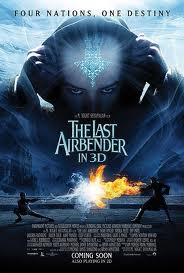
The Last Airbender, a film by M. Night Shyamalan

by James Gilmore

M. Night Shyamalan’s The Last Airbender is nothing short of a fiasco. Watching Airbender is like watching a group of kids play make believe on a $150m budget. Of its scant virtues are a solid midpoint with an interesting twist and beautiful cinematic scenery, neither of which are enough to save this film from ridicule and oblivion.

The plot is a series of anticlimactic events wherein few sources of conflict come to a head in a do-or-die confrontation. The acting lacks any sense of urgency, even at the most critical of moments, and most of the characters appear to have only a narrow range of emotions, most of which consist of being at the brink of bursting into tears at any given moment. Further exacerbating the problem, awkward, immature dialogue is almost exclusively expository and devoid of subtext, castrating every scene of any potential emotional fortitude. Although targeted to a younger audience this does not give the filmmaker an excuse to leave out basic elements of storytelling (contrast Airbender to any Pixar film and one can see the difference is not so much a disparity as a black gaping chasm).

For a director incapable of creating fast-moving action sequences to take on an action film is certainly laudable as a challenge to Night’s filmmaking abilities, but unfortunately the result is an abysmally failed experiment. While is directorial skills remain unquestioned, he should stop writing his own material and stay away from action-oriented films as his own style caters much better to the slow-moving sequences of his earlier works.

Perhaps the most fatal flaw of Airbender is its repeated penchant for “telling” the audience about the world of the film and hardly ever “showing” it. Most of the story is revealed through expository dialogue instead of showing the audience through visual imagery. He takes “show, don’t tell” to the polar opposite, telling the audience about the movie instead of actually illustrating it for us. The oddity is so extreme that one might think there wasn’t enough time/money to finish shooting these sequences, as in the climactic battle of the classical sword-and-sandal epic Cleopatra.

Through his restrained intensity and confident subtlety, Aasif Mandvi is the acting highlight of the film and just about the only positive element in it.

M. Night Shyamalan’s The Last Airbender is a fantasy epic that falls far short of its grandiose aspirations, ultimately coming across as a very expensive B movie (like his previous film, The Happening). It’s safe to say that we won’t be expecting any blood-pumping thrillers or teen heartthrob sensations out of Shyamalan anytime soon—or ever.

Rating: 1.5 / 5

Monday, August 6, 2012

Conan the Barbarian, a film by Marcus Nispel


By James Gilmore

Don’t go into Marcus Nispel’s Conan the Barbarian expecting an expert remake of the 1982 classic by John Milius.  You won’t get it.

The 2011 Conan is an action-soaked bonanza without any pretense at storytelling depth.  Nispel bombards our senses through an orgy of stylization and violence in an attempt to mask its slender content, but no amount of polished veneer can obscure the shallowness beneath.  The storytelling is clumsy and repetitive at best, hyper-extending itself to stretch a thin 60-minute perfunctory plot over two painstaking hours in an endless string of action vignettes in which the audience is whisked through time and space to a number of noncontiguous historical eras.

(Let’s not mention the fact that the acting and poorly written dialogue are enough to make you want to run for the hills.)

Movie poster for Conan the Barbarian remake 2011, a film by Marcus Nispel, on Minimalist Reviews.
Visually, Conan is a gruesome mishmash of every other fantasy film ever made, numerous elements being ripped almost directly out of better, more fulfilling constituents of the genre (which shall remain unnamed).

As for the character Conan, he is barely a character at all.  Employing the oft-overused-in-Hollywood clichĂ© as his template, this impetuous hot-headed central character is more an excuse to paste the screen with gore than a true protagonist.

The only accomplishment worth lauding Conan for is the duping of Hollywood into spending $70 million on what is essentially an expensive-looking B movie.  And Hollywood executives wonder why audiences won’t pay up at the box office to see piles of sugar-coated poo...

(Meanwhile, thousands of excellent scripts waste away on shelves, unread.)

So if you’re up to stuffing a handful of dollar bills down the garbage disposal or want to watch actors don ridiculous costumes and douse each other in fake blood for an evening, pick up a copy of Marcus Nispel’s Conan the Barbarian.  If you are a fan of his kitschy horror resume then you will probably take this bloated little number in stride.

Otherwise, see aforementioned garbage disposal.

Rating:  1.5 / 5

Tuesday, June 12, 2012

Eight Hundred Leagues on the Amazon, a novel by Jules Verne

By James Gilmore

Among the great works of literature by Jules Verne are such classics as Twenty Thousand Leagues Under the Sea, A Journey to the Center of the Earth, Around the World in Eighty Days and The Mysterious Island.  What you will not find nested among those works is a novel called Eight Hundred Leagues on the Amazon (La Jangada is the original title)—and for good reason.  One wouldn’t be so surprised at the quality (or lack thereof) of the novel had it been Jules Verne’s first attempt at the craft, but it mystifyingly appears at the very heart of his career alongside the greats.

Book cover for Eight Hundred Leages on the Amazon, a novel by Jules Verne, on Minimalist Reviews.
Despite pretense of adventure, 800 Leagues is for all intents and purposes a family melodrama with only trace amounts of “adventure.”  The novel is a dull read and hardly believable.  Sorely lack in conflict, the text is often insultingly redundant, the author reiterating known facts in such a fashion that the reader can’t help but feel like he is trying to fill space in a balloon filled with hot hair.  This effectively reduces the pacing of the novel to that of a dying snail.  The linear, predictable story submarines the uneventful plot with rare exception.  Any changes in the story occur entirely by means of deus ex machinae, which leaves the hands of the characters out of events almost entirely, save one or two instances, scuttling their raison d'ĂȘtre.

Overshadowing the weak dramatic impact of the book is the fact that it reads like a pedantic love letter to the Amazon River, like a wan excuse to wax poetic about this illustrious body of moving water.  Although informative, it reduces the novel’s literary value to a mere historical survey of Amazonian river tribes who would cease to exist a century later.

The characters in the novel tend to be shallow in depth and over dramatic.  The antagonist is the most interesting and compelling of the cast.  Unfortunately, his presence is minimal.

Despite some interesting tangents concerning facts about the Amazon River and a few florid descriptions, the novel is thin, flat, artificially contrived and obvious.

A caution to all who tread here: Eight Hundred Leagues on the Amazon is Jules Verne’s worst.  Despite a 5-star rating (from 2 reviews) on Amazon.com at the time of this writing, place this novel on your list of “books to avoid at all costs.”  Feel free to sample the free Kindle book (if you dare).

Rating: 1.5 / 5

Tuesday, February 21, 2012

Blue Gender, an animated series by Ryosuke Takahashi and Koichi Ohata

by James Gilmore

In an attempt to branch out in review material, Blue Gender is this blog’s first Minimalist Review of a TV series—a Japanese anime TV series at that.

Movie poster for Blue Gender, a Japanimation series by Ryosuke Takahashi and Koichi Ohata, on Minimalist Reviews.
Seemingly inspired by another anime series called Neon Genesis Evangelion (and occasionally approaching near plagiarism of it), this 26-episode animated series proves to be an incredibly dark, violent and gory sci-fi that is externally centered around a chosen few individuals who pilot exoskeleton suits (read: big robots) to fight off a global alien invasion.  Internally, the story is about one individual trying to find his purpose in a seemingly pointless existence.

Although the series stays afloat with decent execution, it suffers from numerous logic holes, a unique but blunted concept (a directorial issue, see below), and a bloated, inefficient plot spread too thinly over 26 episodes.  Even though it improves somewhat over time, the whole series still feels two episodes longer than is necessary.  The plot is sometimes too predictable due to directorial shortcomings in dramatizing big reveals, even if they do occur on cue in a solid over-arching structure.  The underlying emotional/relationship content remains adequate for the genre but could have been taken much further given its powerful seeds.  Barely worth mentioning is the all-too-frequent laughable dialogue and occasional clips of unnecessary nudity (justified as “fan service,” which is typical of the anime supergenre).

Despite its numerous shortcomings, Blue Gender remains coherent, well structured, directed, animated and characterized, ultimately leading to a surprisingly entertaining end result, even if the commendable main character has a habit of becoming irritating a little too often.  Testaments to the series’ impressive visuals are its gruesome imagery, realistic future technology, intimidating foes and intense battle sequences, most notable in the first six episodes.  Most striking of all is the uniquely remarkable soundtrack which combines dirty grunge and dark choral with the experimental.

In the end, Blue Gender is worth a look for those into adult sci-fi series featuring an alien invasions, big robots and wholesale slaughter.

Rating: 2 / 5

Tuesday, February 14, 2012

Exterminating Angels (Les anges exterminateurs), a "Quickie" review of the film by Jean-Claude Brisseau

by James Gilmore

Movie poster for Exterminating Angels (Les anges exterminateurs), a film by Jean-Claude Brisseau, on Minimalist Reviews.
Exterminating Angels (Les anges exterminateurs) by Jean-Claude Brisseau should have been a short film.  Bloated with too many shenanigans and not enough story, the film contains all the elements of a deep story but fails to take the necessary steps required to achieve its goal or to adequately explore its thematic material.  In short, it doesn’t provide a qualitative, coherent examination of the subject matter.

Not to downplay the surrealism of E.A., but many of the film’s elements are completely superfluous while the plot is not as solid as it needs to be.  Instead, it seems to act as a vehicle to justify extended scenes of sexual indulgence.

Brisseau makes an attempt at unraveling the ambiguity of sexuality and sexual love, but the result is shallow despite its proposed depth and, if anything, comes across as simply old-fashioned.  One can’t help but feel like the filmmaker thought he was being clever while sending a personal message of defiance directed toward his critics.  However, the result is incoherent and superficial.

Rating:  2 / 5

Thursday, January 19, 2012

The Mothman Prophecies, a film by Mark Pellington

by James Gilmore

The most remarkable feature of The Mothman Prophecies is its arrestive visual acumen and atmosphere.  Not a minute goes by without haunting imagery gracing the screen.

Movie poster for The Mothman Prophecies, a film by Mark Pellington, on Minimalist Reviews.
Unfortunately, the story is weak at best, and its interlocking pieces ragged, tired, or forced.  Although the supernatural entity known as “the Mothman” is supposedly the lynchpin of the story, he need not exist at all since the plot involves a number of individuals having prophetic visions, and the fact that the Mothman sometime appears in them is only incidental.  Also superfluous to the plot is the main character’s relationship with his wife (the focus of the B Story), which fails to have any conclusive ending nor any reason for inclusion in the film except as a weak initial impetus to move the protagonist to the remote location of Point Pleasant, West Virginia.

Laura Linney’s acting performance is worth mentioning.  Despite the minimalist approach to her character, it proves to be one of her best performances and indicative of her serious dramatic acting ability.

This psychological/supernatural thriller is also a borderline horror, and will appeal to those in the mood for an intriguing, even perplexingly illogical, filmic experience.

Rating:  2 / 5

Thursday, October 20, 2011

Ironclad, a film by Jonathan English


by James Gilmore

In my first random pick for review, I selected a film I’d never heard of based on its cast of superb actors.

Ironclad is an exciting action film with a rich, gritty palette and bravely executed combat scenes filled with gore and glory.  Well-designed, efficiently made for its modest budget, but I wouldn’t say well-directed.  ‘Adequate’ is more appropriate.  The film lacks requisite directorial intimacy in pivotal scenes while exposition is handled more like a dialogue-heavy Shakespeare stage play than a filmic story with keen visual moments.  However, the director excels in presenting intense battle scenes—the highlight of the film—much to the viewer’s benefit.

Movie poster for Ironclad a film by Jonathan English on Minimalist Reviews.
This Westernized remake of Kurasawa’s Seven Samurai has a rocky 30 minute start, after which it drastically—thankfully—improves with steady progression for the remainder of the film.  Unfortunately, Ironclad pales in comparison to the stability, complexity or thematic material inherent in Kurasawa’s version.

While it is refreshing to see Paul Giamatti play the villain and, in juxtaposition, Brian Cox as a good guy (their roles are usually reversed), the protagonist (played by James Purefoy) remains inexorably weak.  Without any sense of the proactive goal-seeking or depth required to drive the story, the first act feels directionless and unhinged.  Unfortunately, the protagonist’s deficiencies never correct themselves.  Every character ends up having more depth than and goal-orientation than the protagonist, who presents himself as the classic reactive type, acted upon instead of pro-acting to advance the plot.  His only element of character turns out to be an artificial construct which neither enhances nor develops the story.  Purefoy portrays his character just as weakly, like a beaten dog who tries to shrink into invisibility in order to avoid further beatings.  He is a non-character, and the weakest link at the core of story.

Despite its shortcomings, Ironclad is worth a look if you are in the mood for a superficial action film and aren’t afraid of a little graphic violence.

Rating: 2 / 5

Tuesday, September 13, 2011

Thursday, September 8, 2011

I Love You, Man, a film John Hamburg

Movie poster for I Love You Man, a film by John Hamburg, on Minimalist Reviews.by James Gilmore

Too many shenanigans, not enough story (common problem in feature comedies).  While Paul Rudd is extremely likeable, he does not have the presence or ability to carry the success of an entire feature on his back.  Great concept, adequate execution, some funny bits, but otherwise not worth the time.

2 / 5

Wednesday, May 25, 2011

Strange As This Weather Has Been, a literary novel by Ann Pancake

by James Gilmore

Book cover for Strange As This Weather Has Been, a literary novel by Ann Pancake, on Minimalist Reviews.
Aside from being slammed in the face with a sledgehammer labeled "Mountaintop removal mining is BAD" every paragraph, Strange As This Weather Has Been delivers strikingly eloquent characters and prose with unparalleled craftsmanship.

Many elements illustrate or elaborate the themes in the novel quite well while far too many seem to serve no other purpose than redundant milieu. For those who relish character work and language this is the book for you, but general readership will find it a work of willpower as they struggle to overcome breathtaking boredom due to a near-complete lack of forward story progress.

Although an enviously gifted writer, Pancake should consider serious outlining before writing her next novel or stick to her specialty: literary short stories about Appalachia.

Rating: 2 / 5