Showing posts with label adventure. Show all posts

Tuesday, November 12, 2013

Star Trek: Into Darkness, a film by J.J. Abrams

J.J. Abrams’s long anticipated sequel Star Trek: Into Darkness outdoes its predecessor in action, intensity and spectacle. Despite a running time of 2:12 (132 min) the film feels a little too short to play out the struggle between the protagonists and the main antagonist, played by Benedict Cumberbatch. The saturation of fan service and cross-references to other events in the Star Trek universe is an unending treat for fans of the franchise but at times detrimental, especially when it results in lines of hokey dialogue. A simple substitution of one of the film’s mindless action scenes for a short sequence to deepen character and theme development would have greatly benefited Into Darkness.

The first Star Trek took us with surprise by the acting intensity portrayed by its young cast. Into Darkness retains the same cast but fails to carry over the compelling emotional punch from its prequel. Part of this failure results from the from the disappointing script characterization of several cast members, namely Kirk, Spock, and Uhura. Benedict Cumberbatch proves the exception to this rule in his portrayal of the notorious Khan.

The biggest issue in Into Darkness is with the main antagonist, Khan. As one of the most intelligent and complex characters in the Star Trek Universe, more story and screen time oriented toward exploring the character’s intricacies is required in order for his personal journey to feel complete by the conclusion of his story arc. Instead of actually exploring the character, the story turns him into a 1-dimensional foe with no further development beyond the mid-point—a sad misappropriation of story potential. Much more could have been made of his shifting ally/enemy role as well but the film took the easy way out with his character, thereby losing both strength and depth as a result.

One of the most exciting films of the 2010s.

Rating: 3.5 / 5

Monday, February 18, 2013

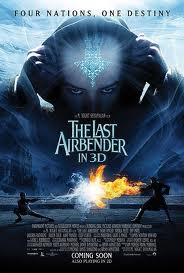
The Last Airbender, a film by M. Night Shyamalan

by James Gilmore

M. Night Shyamalan’s The Last Airbender is nothing short of a fiasco. Watching Airbender is like watching a group of kids play make believe on a $150m budget. Of its scant virtues are a solid midpoint with an interesting twist and beautiful cinematic scenery, neither of which are enough to save this film from ridicule and oblivion.

The plot is a series of anticlimactic events wherein few sources of conflict come to a head in a do-or-die confrontation. The acting lacks any sense of urgency, even at the most critical of moments, and most of the characters appear to have only a narrow range of emotions, most of which consist of being at the brink of bursting into tears at any given moment. Further exacerbating the problem, awkward, immature dialogue is almost exclusively expository and devoid of subtext, castrating every scene of any potential emotional fortitude. Although targeted to a younger audience this does not give the filmmaker an excuse to leave out basic elements of storytelling (contrast Airbender to any Pixar film and one can see the difference is not so much a disparity as a black gaping chasm).

For a director incapable of creating fast-moving action sequences to take on an action film is certainly laudable as a challenge to Night’s filmmaking abilities, but unfortunately the result is an abysmally failed experiment. While is directorial skills remain unquestioned, he should stop writing his own material and stay away from action-oriented films as his own style caters much better to the slow-moving sequences of his earlier works.

Perhaps the most fatal flaw of Airbender is its repeated penchant for “telling” the audience about the world of the film and hardly ever “showing” it. Most of the story is revealed through expository dialogue instead of showing the audience through visual imagery. He takes “show, don’t tell” to the polar opposite, telling the audience about the movie instead of actually illustrating it for us. The oddity is so extreme that one might think there wasn’t enough time/money to finish shooting these sequences, as in the climactic battle of the classical sword-and-sandal epic Cleopatra.

Through his restrained intensity and confident subtlety, Aasif Mandvi is the acting highlight of the film and just about the only positive element in it.

M. Night Shyamalan’s The Last Airbender is a fantasy epic that falls far short of its grandiose aspirations, ultimately coming across as a very expensive B movie (like his previous film, The Happening). It’s safe to say that we won’t be expecting any blood-pumping thrillers or teen heartthrob sensations out of Shyamalan anytime soon—or ever.

Rating: 1.5 / 5

Wednesday, November 7, 2012

Super 8, a film by J.J. Abrams

by James Gilmore

Super 8: think The Goonies with a touch of Cloverfield flavoring. A modernized 1940s pulp brought to life in the style of 1980s family adventure movies, watching Super 8 is in many ways like reliving the nostalgic childhood you never had.
movie poster for Super 8 for Minimalist Review blog

While the ambiance is an undeniable factor in drawing the audience into the world of the story, what really sells the film is the remarkable chemistry within the cast. In no small feat, Abrams manages to garner authentic performances from his child actors from fade in to fade out.

While character chemistry and ambiance stand out in Super 8, the film is not without its pitfalls. Super 8 lacks the depth of Abrams’ other works, especially in terms of plot, which proves itself to be somewhat thin and predictable, making for a somewhat hollow filmic experience in what could have been a magical one. Nevertheless, parts of the film are memorable, especially the mini film-within-a-film which plays during the end credits.

In spite of its slender plot, Super 8 remains a wholesome thriller that is sure to stand as one of the greatest youth adventure films since The Goonies.


Rating: 4 / 5

Monday, October 8, 2012

1632, an alternative history novel by Eric Flint


By James Gilmore

Eric Flint’s 1632 is an alternative history science fiction novel about a small town in present day West Virginia that is suddenly transported back in time to Germany during the devastating Thirty Years’ War in the year 1632.  At its heart, 1632 is a romantic view of classic American ideals clashing with and conquering those of the oppressed, war-torn 17th century continental Europe, pushing normal small town folk into extraordinary circumstances.

Book cover for 1632, an alternative history novel by Eric Flint, on Minimalist Reviews.
Eric Flint executes the unusual and exceptionally difficult premise with marvelous ease and methodical reasoning, exploring the promise of the premise with detailed thoroughness.  Despite reviews which misleadingly describe the book as “action packed”  1632 is mostly a relationship-oriented piece with a few periods of intense action counterpointed against extended laconic sections of blossoming romance.

The plentiful characters populating the novel surprise the reader with their variance, color, and very human likeability, which makes the exploration their relationships a pleasure, even if the story does get bogged down in a disproportionate amount of romance during the second act.  The large cast prevents great depth in character development.  Regardless, it’s obvious to the reader that Flint is an author who genuinely loves his characters.

One of the greatest shortcomings of 1632 is its failure to live up to the high stakes generated by the premise.  Main characters have things pretty easy and rarely (if ever) actually lose anything of value, while any obstacles that do arise are circumvented without great difficulty.  Greater challenges and higher stakes conflict are needed in a world where innumerable dangers lurk in the shadows.  Unfortunately, the dangers threaten but seldom actually emerge from the periphery.

Eric Flint’s 1632 may be an acquired taste for most, but don’t hesitate to pick up a copy if you are in the mood for something new, unique and quasi-historical.

Rating:  3.5 / 5

Monday, August 6, 2012

Conan the Barbarian, a film by Marcus Nispel


By James Gilmore

Don’t go into Marcus Nispel’s Conan the Barbarian expecting an expert remake of the 1982 classic by John Milius.  You won’t get it.

The 2011 Conan is an action-soaked bonanza without any pretense at storytelling depth.  Nispel bombards our senses through an orgy of stylization and violence in an attempt to mask its slender content, but no amount of polished veneer can obscure the shallowness beneath.  The storytelling is clumsy and repetitive at best, hyper-extending itself to stretch a thin 60-minute perfunctory plot over two painstaking hours in an endless string of action vignettes in which the audience is whisked through time and space to a number of noncontiguous historical eras.

(Let’s not mention the fact that the acting and poorly written dialogue are enough to make you want to run for the hills.)

Movie poster for Conan the Barbarian remake 2011, a film by Marcus Nispel, on Minimalist Reviews.
Visually, Conan is a gruesome mishmash of every other fantasy film ever made, numerous elements being ripped almost directly out of better, more fulfilling constituents of the genre (which shall remain unnamed).

As for the character Conan, he is barely a character at all.  Employing the oft-overused-in-Hollywood cliché as his template, this impetuous hot-headed central character is more an excuse to paste the screen with gore than a true protagonist.

The only accomplishment worth lauding Conan for is the duping of Hollywood into spending $70 million on what is essentially an expensive-looking B movie.  And Hollywood executives wonder why audiences won’t pay up at the box office to see piles of sugar-coated poo...

(Meanwhile, thousands of excellent scripts waste away on shelves, unread.)

So if you’re up to stuffing a handful of dollar bills down the garbage disposal or want to watch actors don ridiculous costumes and douse each other in fake blood for an evening, pick up a copy of Marcus Nispel’s Conan the Barbarian.  If you are a fan of his kitschy horror resume then you will probably take this bloated little number in stride.

Otherwise, see aforementioned garbage disposal.

Rating:  1.5 / 5

Tuesday, June 26, 2012

Pirate Latitudes, a novel by Michael Crichton


By James Gilmore

Book cover for Pirate Latitudes, a pirate novel by Michael Crichton, on Minimalist Reviews.Pirate Latitudes is taut genre novel written by one of the modern masters of suspense, Michael Crichton.  Intense and inventive, the action and drama never fail to entertain in a story laden with clever ideas in plotting and execution while widely diverse, fascinating characters populate the novel.  Crichton fulfills and defies every pirate cliché by making them his own, transforming each element into something unique and poignant and exploring to its logical, if not surprising, conclusion.

Unfortunately, Pirate Latitudes once again exhibits Crichton’s two major weaknesses: (1) his talent for gullibly accepting stereotypes (valid or not) based on his research, and (2) failing to provide any greater depth or meaning beyond the story itself, which is where the limit of the story’s impact can be felt most.

A thrilling ride for Crichton and pirate lovers; a guilty pleasure for lit-heads.

Rating: 3 / 5

Tuesday, June 12, 2012

Eight Hundred Leagues on the Amazon, a novel by Jules Verne

By James Gilmore

Among the great works of literature by Jules Verne are such classics as Twenty Thousand Leagues Under the Sea, A Journey to the Center of the Earth, Around the World in Eighty Days and The Mysterious Island.  What you will not find nested among those works is a novel called Eight Hundred Leagues on the Amazon (La Jangada is the original title)—and for good reason.  One wouldn’t be so surprised at the quality (or lack thereof) of the novel had it been Jules Verne’s first attempt at the craft, but it mystifyingly appears at the very heart of his career alongside the greats.

Book cover for Eight Hundred Leages on the Amazon, a novel by Jules Verne, on Minimalist Reviews.
Despite pretense of adventure, 800 Leagues is for all intents and purposes a family melodrama with only trace amounts of “adventure.”  The novel is a dull read and hardly believable.  Sorely lack in conflict, the text is often insultingly redundant, the author reiterating known facts in such a fashion that the reader can’t help but feel like he is trying to fill space in a balloon filled with hot hair.  This effectively reduces the pacing of the novel to that of a dying snail.  The linear, predictable story submarines the uneventful plot with rare exception.  Any changes in the story occur entirely by means of deus ex machinae, which leaves the hands of the characters out of events almost entirely, save one or two instances, scuttling their raison d'être.

Overshadowing the weak dramatic impact of the book is the fact that it reads like a pedantic love letter to the Amazon River, like a wan excuse to wax poetic about this illustrious body of moving water.  Although informative, it reduces the novel’s literary value to a mere historical survey of Amazonian river tribes who would cease to exist a century later.

The characters in the novel tend to be shallow in depth and over dramatic.  The antagonist is the most interesting and compelling of the cast.  Unfortunately, his presence is minimal.

Despite some interesting tangents concerning facts about the Amazon River and a few florid descriptions, the novel is thin, flat, artificially contrived and obvious.

A caution to all who tread here: Eight Hundred Leagues on the Amazon is Jules Verne’s worst.  Despite a 5-star rating (from 2 reviews) on Amazon.com at the time of this writing, place this novel on your list of “books to avoid at all costs.”  Feel free to sample the free Kindle book (if you dare).

Rating: 1.5 / 5